9. Transferring the vowel of the hamzah to the
saakin letter before it
Transferring the vowel of the hamzah to the
saakin letter before it
When the last letter
of a word is not a medd letter and is saakin, and the first letter of the
next word is a
 ,
, Warsh transfers the vowel of the hamzah to the saakin letter before it,
and the hamzah is dropped in pronunciation. Examples of this are:
,
, Warsh transfers the vowel of the hamzah to the saakin letter before it,
and the hamzah is dropped in pronunciation. Examples of this are:
 ,
,
 , and
, and 
Included
in this is the
 or
alif laam at-ta’reef, which is a different word than the noun it defines.
Examples are:
or
alif laam at-ta’reef, which is a different word than the noun it defines.
Examples are:
 ,
,
 , and
, and
 .
When starting a word that has a hamzah qaTa’ after the alif lam “ta’reef”
when reading Warsh, there are two allowed ways of reading:
.
When starting a word that has a hamzah qaTa’ after the alif lam “ta’reef”
when reading Warsh, there are two allowed ways of reading:
a.
If
it is considered as it is originally, then start with the hamzah wasl (with
a
 ), then transfer the
vowel of the hamzah qaTa’ that follows the
to
the
), then transfer the
vowel of the hamzah qaTa’ that follows the
to
the  . The word
is
pronounced
. The word
is
pronounced

b.
If it is
considered a conditional occurrence (because of the now voweled
)
then we can start with the
,
with its transferred vowel and there is no need to start with the hamzah
wasl, which is used to take us to a saakin letter. The word
is then pronounced as
 .
.
If a word
starting with
,
then a
,
and then a  ,
such as in:
or
,
such as in:
or
 there
are conditions as to which way we start and how much we can lengthen the
medd badl. If we start with the ,
not the hamzah al-wasl, then we can read the medd badl with two vowel counts
only. If we start with the hamzah al-wasl then the three different lengths
for the medd badl are allowed (2, 4 or 6 vowel counts).
there
are conditions as to which way we start and how much we can lengthen the
medd badl. If we start with the ,
not the hamzah al-wasl, then we can read the medd badl with two vowel counts
only. If we start with the hamzah al-wasl then the three different lengths
for the medd badl are allowed (2, 4 or 6 vowel counts).
Warsh has
two allowable ways of reading the word
 in aayah 19 of surah Al-Haaqqah, when
read in continuum; joining it with the first word of the next aayah:
in aayah 19 of surah Al-Haaqqah, when
read in continuum; joining it with the first word of the next aayah: ;
;
 :
:
a.  of the vowel on the hamzah on the word
to the
of the vowel on the hamzah on the word
to the
 of the word
.
of the word
.
b. Leaving
out the
and
joining the two aayah with a sukoon on the
.
* If joining aayah 19
in recitation with the aayaat that follow until:  ,
there are
conditions for joining aayah 28 with 29. When reading
,
there are
conditions for joining aayah 28 with 29. When reading
 with
of the vowel on the hamzah to the
,
is read with idghaam of the first
into the second. When
reading with
the absence of
,
is read with
with
of the vowel on the hamzah to the
,
is read with idghaam of the first
into the second. When
reading with
the absence of
,
is read with
 of the
first and a
of the
first and a
 between the two words.
 ,
of surah An-Najm aayah 50, is read with idghaam of the tanween into the
and
the vowel on the hamzah of the word
is transferred to
the
(
) with the hamzah dropped (as usual in the case of
), as in:
,
of surah An-Najm aayah 50, is read with idghaam of the tanween into the
and
the vowel on the hamzah of the word
is transferred to
the
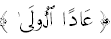
(
) with the hamzah dropped (as usual in the case of
), as in:
 .
.
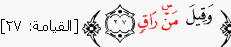
Warsh reads the
following all without a sakt, and applies the appropriat rules for the noon
saakinah and tanween, as well as the laam saakinah:
 ,
,


There is no
change with the Arabic rule for two saakin letters meeting in the
recitation of Warsh, even though the laam of ta’reef acquires a
vowel with the .
If there is a word that has an incidental vowel before the laam of
ta’reef with a , the incidental vowel does not change and stays,
just as a dropped medd letter stays the same.